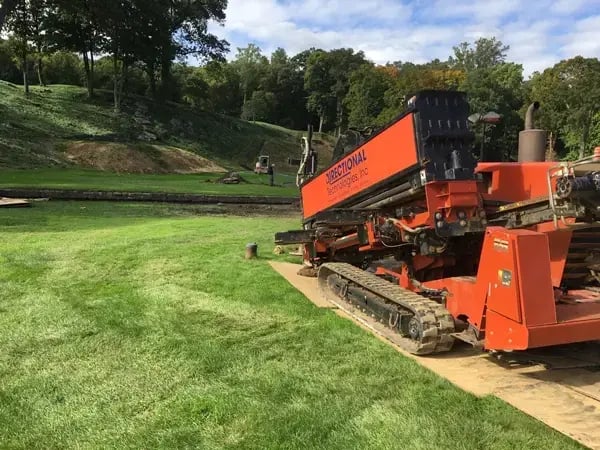
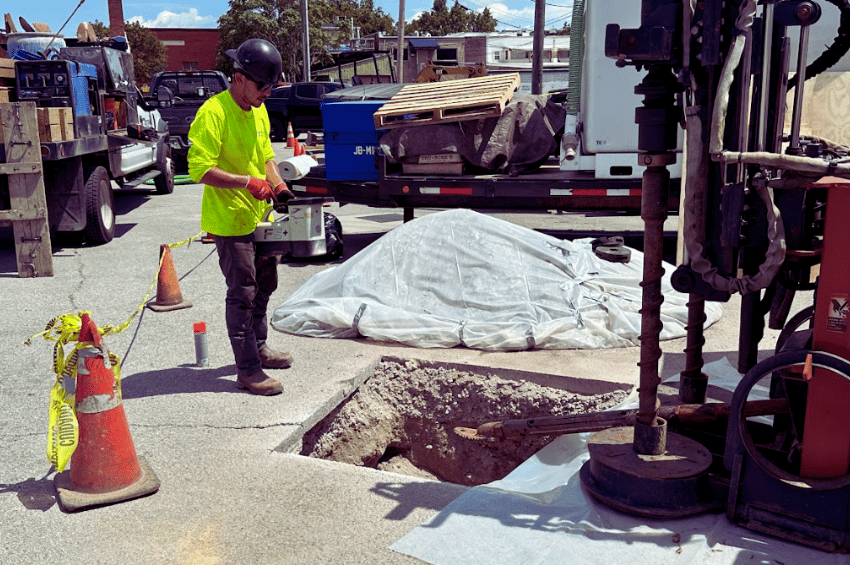
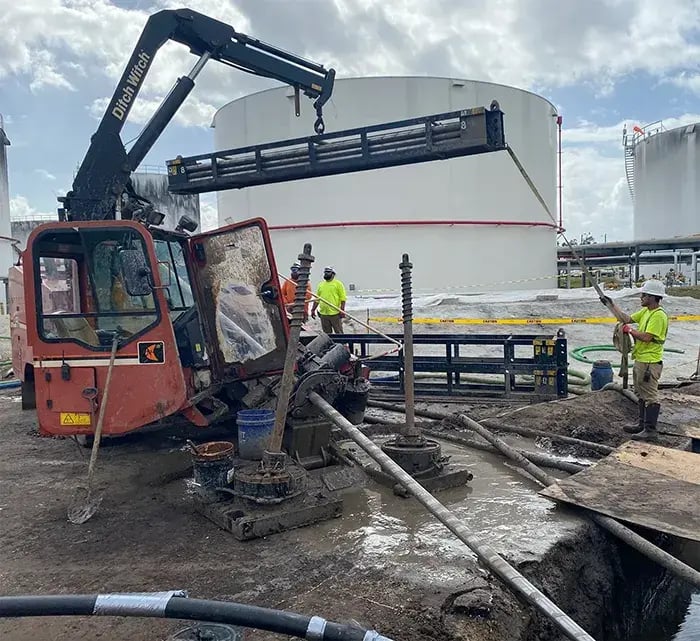
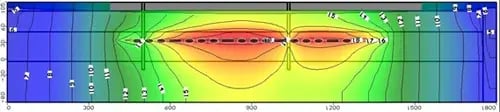
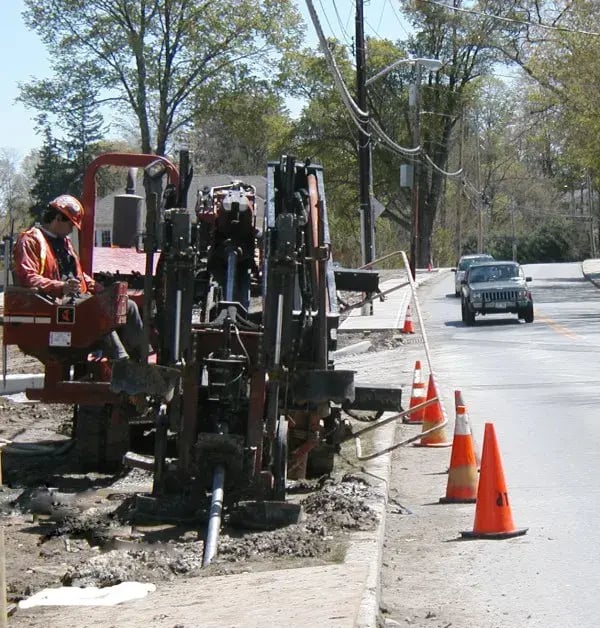
Horizontal soil vapor extraction wells are an ideal solution to combat harmful vapors from intruding into occupied buildings. Due to their orientation, they can be installed directly beneath building foundations to intercept soil contamination and reroute it to a safe location.
Soil vapor extraction (SVE) is a common solution for soil remediation, but often getting to the contamination is the most difficult step. Too many times contaminated sites remain active years beyond their lifespan simply because there is residual contamination located beneath a surface-level obstruction. Vertical wells installed along building perimeters can slowly chip away at spreading soil contamination, but the reality is that these systems cost money to operate, and clients don’t like spending money. The goal, then, is to knock out the contamination quickly and efficiently. Horizontal remediation wells offer several advantages for soil vapor extraction, making them an effective solution monetarily and performance-wise. Through horizontal directional drilling techniques, horizontal soil vapor extraction wells can provide access to hard-to-reach places. Soil contamination can exist beneath roads, buildings, railroads, storage tanks, and more, all of which are areas that are inaccessible with vertical wells. This is particularly important in situations where vapor intrusion is a threat to business operations. Horizontal soil vapor extraction wells can be installed directly below the building footprint, running parallel beneath the building foundation to provide enhanced coverage against harmful vapors.
Horizontal wells reduce surface disruptions and restorations compared to vertical wells because multiple wells can be drilled and installed from one drilling pit. Several soil vapor extraction wells can be installed in a fan-like layout to provide maximum lateral coverage while consolidating the wellheads into one central location. This is particularly useful at sites that are constrained in urban or sensitive environments where vertical drill rigs do not have the space to operate.
Soil vapor contamination does not just exist in access-restricted locations. Anywhere there is groundwater contamination, there is a potential for vapors to volatilize and migrate upward into the vadose zone. Horizontal wells can be installed with hundreds of feet or more of linear feet per well, providing improved efficiency as there is more surface area of the well in contact with the contamination. As a result, significantly more contaminant vapor can be captured and rerouted to the remediation system for treatment
Horizontal soil vapor extraction wells provide significantly more contact with the contaminated soil to greatly enhance the capture zone of harmful vapors. If you have ongoing projects with residual contamination, it’s time to finally bring them to closure. Directional Technologies is happy to help evaluate how horizontal wells may be a good fit for your site. That’s what we’re here for.
Effectively Saturate a Treatment Zone
In order to create a successful bioamendment barrier in a traditional vertical remediation well design, the radius of influence must propagate far enough into the formation to overlap with the radius of influence of the adjacent wells in the barrier. Gaps in the amendment barrier provide conduits for contamination to seep through and continue downgradient.
Horizontal remediation wells provide continuity across the well screen during the injection process and ensure that the treatment zone is effectively saturated with the remedial amendment.
Traditional in-situ bioremediation techniques, such as vertical well injections, often result in invasive designs and lengthy remediation timelines. Tens of injection wells, or more, may be required in order to inject the proposed amendment volume. One horizontal remediation well can often replace several vertical wells in order to remediate the same target area, eliminating unnecessary additional well construction in the subsurface and obstructive well vaults at the surface.
Source-area contamination is often difficult to reach, and without intercepting the proper preferential pathways vertical wells can struggle with delivering the full amendment volume. If time and efficiency are important factors when applying bioremediation at your site, horizontal remediation wells are the preferred method to achieve your project goals.
Horizontal air sparge wells are geometrically oriented to provide more well-screen contact with the contaminant mass.
As a result, the increased volatilization significantly reduces dissolved-phase groundwater contamination, bringing sites to closure faster and keeping clients happy.
If you’re using air sparging techniques to target groundwater contamination, do you want more screen contact with the contamination, or less? If the goal is to achieve site closure in a shorter amount of time, then more screen contact is necessary. While vertical wells typically contain 10s of feet of screen, horizontal wells often contain hundreds of feet or more. This is particularly useful in air sparging situations because groundwater plumes are almost always more extensive in the lateral direction than the vertical. It makes sense, then, to install a horizontal well that is parallel to the geometric orientation of the groundwater plume rather than perpendicular to it.
Horizontal air sparge wells are particularly useful in situations where the contamination resides beneath an existing structure. It is common for volatile organic carbon (VOC) contamination to exist in places where traditional vertical techniques have difficulty reaching, such as beneath fuel storage tanks or dry cleaners.
The inability to access source area contamination can keep sites open for years beyond their scheduled timeline. In these situations, the horizontal well can be installed beneath the building or obstruction, targeting the contaminated groundwater with increased volumes of airflow.
While horizontal wells are an excellent technology for providing access to difficult locations, they also function as excellent sparge barrier wells in areas where access is not an issue at all. Typical vertical barriers may require several tens of wells in a row, relying on preferential pathways to provide remedial communication between them. One horizontal well with hundreds of feet of screen can replace an entire row of vertical barrier wells. The increased oxygen delivered via the horizontal air sparge remediation well will enhance the biodegradation process.
Horizontal air sparge wells provide significantly more oxygen to the contaminated groundwater due to increased screen footage and compatible orientation. One horizontal well may replace the proposed vertical system at your next site, while providing a higher performance and reducing the remedial timeline.
Contact One of Our Environmental Experts Today!
Have a project or interested in learning more about how horizontal remediation can help you achieve site closure?