What options are available to overcome restrictive site conditions that would otherwise impact your remediation projects? Obstacles like no building access, cramped site layouts, heavily trafficked areas, dense networks of underground utilities, and various other factors common with operating businesses and active properties can become limitations that affect vertical remediation well placement and contribute to poor in-situ remediation system performance. In the case of one consultant’s dry cleaner remediation project, their answer to the many challenges posed by their site was horizontal remediation wells.
A former dry cleaner at a busy strip mall had created a large chlorinated solvent groundwater plume that had spread to adjacent properties.
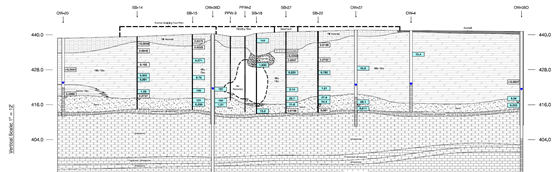
The geology consisted of silty clay down to approximately 22 feet, underlain by a sandy layer approximately 5 feet thick, with bedrock starting around 27 feet below ground surface. The depth to groundwater was approximately 26 feet. Groundwater solvent concentrations were detected from the top of groundwater to the restrictive bedrock layer and elevated chlorinated solvent concentrations were present in a more limited area of shallow soils concentrated around the source area.
The consultant was tasked with remediation of both the widespread groundwater contamination as well as the more localized soil contamination. They had identified that the most effective in-situ method of remediating the groundwater was a Zero Valent Iron (ZVI) injection and the most effective in-situ method of remediating the soil was electrical resistivity heating (ERH).
Yet they were faced with the following restrictive site conditions:
In short, there were an abundance of constraints that existed on this site which affected their ability to successfully achieve their remediation goals. Initial conceptual designs for vertical wells to treat the groundwater were met with frustration. Not only would the vertical wells have limited access to the most highly concentrated areas of the plume (due to the uncooperative tenants and neighbors), but the cost to install and operate them would be substantial due to the fees associated with reserving areas of the parking lot.
In their search for ways to improve on their initial designs for the project, the consultant reached out to Directional Technologies for alternative perspectives. Working through various iterations of conceptual designs, the team was able to establish a conceptual remedial design using horizontal wells to replace the need for most vertical wells. The final design incorporated ERH in the shallow soils adjacent to the source area and a series of horizontal injection wells that fanned out across the plume.
To ensure optimal distribution of the injectable amendment, the consultant, Directional Technologies, and the firm providing the ZVI coordinated on the well screen design. After evaluating lithologic conditions, particle size, and the physical properties of the amendment, Directional Technologies developed a custom-engineered and site-specific well screen design to ensure optimal distribution of the product into the contaminated zones.
Using horizontal wells, the consultant found they could:
Horizontal wells are an effective solution to bring regulatory site closure to challenging sites, no matter the site conditions. With the proper equipment, techniques, and experience provided by Directional Technologies, horizontal remediation wells can be successfully implemented at sites that present many restrictions that might otherwise make remediation impossible.
Do your projects have contaminant plumes that are difficult to access due to site conditions? Call our horizontal remediation well experts at 1-877-788-4479 to discuss your current project needs.