Both conventional vertical wells and directionally drilled horizontal remediation wells have a screen connected to a solid riser which leads to the ground surface. Groundwater or soil vapor is drawn through a well screen to remove contaminants. Remediation agents such as air, bioadmendments or chemical oxidant are injected through a well screen to treat contaminants in situ. This is where the similarities end.
Horizontal remediation wells have important practical benefits, independent of the selected in situ remediation technology.
Horizontal remediation wells can be adapted to many in situ remediation technologies, including:
Enhanced bioremediation involves injection of air, nutrients or other amendments into the contaminated zone to stimulate microbial growth and promote contaminant degradation. The significantly greater screen surface area provided by horizontal wells allows for more efficient delivery and distribution of amendments as compared to vertical wells. Increased screen surface area is particular advantageous in diffusion-driven delivery of some bioamendment materials.
AS/SVE technology involves 1) introduction of microscopic air bubbles (AS) below the water table to enhance not only bioremediation but also contaminant volatilization; and 2) extraction of volatile organic compound vapors above the water table (SVE). This proven technology removes dissolved and absorbed contaminants from the saturated and vadose zones without extracting groundwater to the surface for treatment.
Due to the long screened interval (increased surface area) and linear configuration, horizontal wells more effectively distribute air into and extract vapors from the impacted zone.
Directional Technologies has many success stories using horizontally-deployed AS/SVE to remediate releases at airports, petroleum terminals, refineries and pipelines. The impacted media in each case consisted of soils and groundwater with dissolved and adsorbed constituents and free-phase liquid. This technology deployment approach can successfully mitigate a contaminant plume flowing off-site, protecting down-gradient receptors.
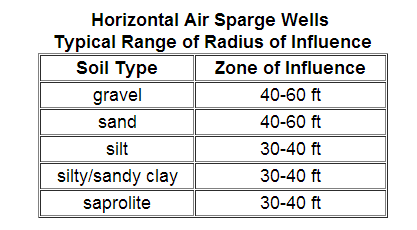
In an article titled “Horizontal Biosparge Wells Treat Petroleum Free Product” (Horizontal News Volume 8/Number 1, Fall 2005) Louis B. Fournier, PhD, reported that a typical vertical sparge well has a radius-of-influence (ROI) of less than 20’ around the well screen. Horizontal sparge wells typically have a ROI of 40’ on each side of the well screen. For this reason horizontal wells provide superior physics of delivery and substantially greater screen contact area with impacted media than a vertical sparge well. Similarly, this results in greater contaminant removal via SVE.
Additionally, according to Dr. Fournier, if free phase liquid is present, vertical sparge wells can “push” the separate phase liquid away from the well screens. EPA guidance suggests that the presence of separate phase petroleum may prevent vertical sparge wells from remediating a contaminated site due to free phase migration away from the vertical well screen. While there is some free phase migration away from a horizontal well screen, it must travel much further to escape the treatment zone due to the much larger ZOI. Horizontal biosparge wells can be designed to minimize mounding and control free phase migration.
A single horizontal well is in contact with a significantly larger area of impacted soil or groundwater and therefore can treat a larger contaminant mass compared to a typical vertical well with a 10-foot long screen. Since only one submersible pump is needed in a horizontal well system compared to typically five or more pumps in a comparable vertical well system, savings can be realized in both up-front capital costs and long-term O&M costs.